
“The task of the mapmaker is to find the proper place for everything”
As we prepare for this year’s Schumacher Summer School, I’ve been rereading E.F. Schumacher’s A Guide for the Perplexed. Nearly fifty years after it was first published, it is amazing how relevant it feels today.
Most people know Schumacher through Small Is Beautiful, the book that challenged conventional economics and inspired generations of thinkers and practitioners working on local economies, appropriate technology and human-scale development. But A Guide for the Perplexed goes deeper. It asks a more fundamental question: how do we make sense of the world?
Schumacher believed that our deepest crises are not primarily economic, political or technological. They are crises of understanding.
Never before have we had access to so much information. We carry the world’s knowledge in our pockets. Artificial intelligence can answer almost any factual question in seconds. Scientific and technological progress continues at an astonishing pace.
And yet many people feel more disoriented than ever.
We face ecological breakdown, growing inequality, political polarisation, loneliness and a widespread sense that something is missing. We know an extraordinary amount about the world, but often struggle to answer simpler questions: What is a good life? What do we owe one another? How should we live within the limits of the Earth? What is our responsibility to future generations?
For Schumacher, knowledge and wisdom are not the same thing. One of the most powerful ideas in A Guide for the Perplexed is that we need two maps: a map of knowledge and a map for living.
The first helps us understand how the world works. The second helps us understand our place within it.
Schumacher writes that the task of the mapmaker is to find the proper place for things. When things are out of place, they become invisible. Worse still, their place is often occupied by something that doesn’t belong there at all, leading us further astray.
Perhaps many of today’s crises are, at heart, crises of orientation. We have become incredibly skilled at mapping markets, technologies and production systems, but much less skilled at mapping relationships, stewardship, beauty, community and our place within the living world.
How might education help us find our place in the world?
That question has become one of the foundations of this year’s International Schumacher Summer School.
Rather than organising the programme around academic disciplines, we are shaping it around six interconnected strands that we believe are essential for navigating the challenges of our time.
- Knowing ourselves — cultivating self-awareness, ethics, purpose, intuition and judgement.
- Understanding living systems — learning how nature works and recognising that we are part of interconnected ecological and bioregional systems.
- Reimagining economics — exploring the commons, stewardship, cooperation, local economies and regenerative finance as ways of organising economic life around relationships rather than extraction.
- Learning through practice — recognising that wisdom is embodied. Working with our hands, growing food, making things and learning through experience are as important as intellectual understanding.
- Living in community — learning how to collaborate, govern together, navigate conflict and care for shared resources.
- Cultivating beauty and imagination — making space for art, music, storytelling, silence and time in nature. Not as optional extras, but as essential ways of experiencing and making sense of the world.
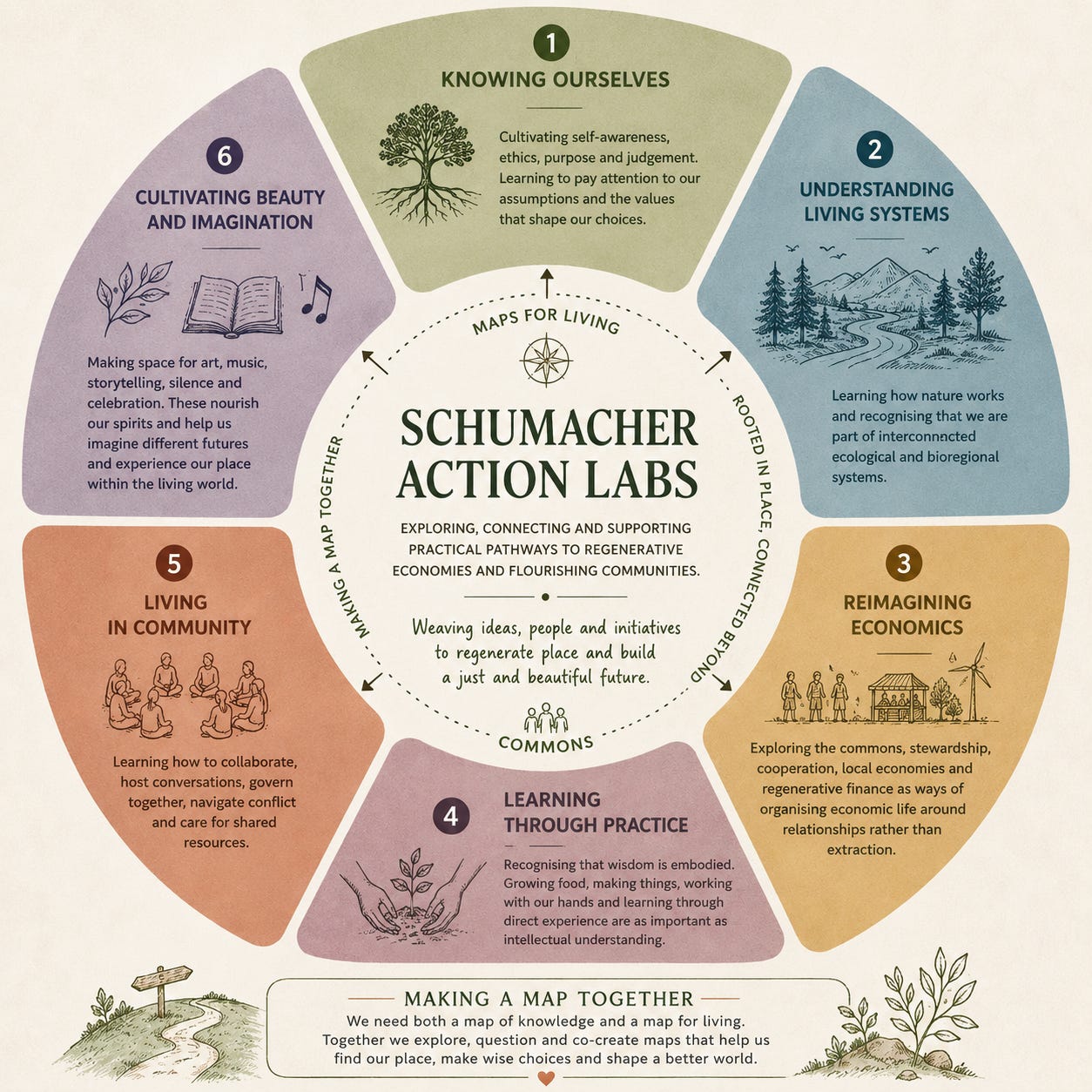
These six strands shape not only what we explore, but how we learn.
We’ll spend time outdoors. We’ll share meals. We’ll hear from practitioners as well as scholars. There will be practical workshops, conversations, music, reflection and time simply to be together. Because wisdom isn’t something that can be downloaded. It grows through relationships, practice and lived experience.
In many ways, this also reflects the extraordinary legacy of Schumacher College. Its contribution was not simply the subjects it taught, but the way it brought together ecology, economics, philosophy, practical work, creativity and community into a living educational experience. Our Summer School draws inspiration from that tradition while also building on the work of the Schumacher Center for a New Economics, the commons movement, bioregionalism and the many communities already experimenting with new ways of living and organising.
If A Guide for the Perplexed speaks to you, if you’re looking for four days to slow down, think deeply, learn with others and explore what a Schumacher-inspired education might look like in practice,I hope you’ll consider joining us in the South of the Netherlands (1,5 hours from Amsterdam by train) . We still have a few places available, and we’d love to welcome you!