
Jay Tompt recently wrote a thoughtful essay about the role education could play in what he calls the next great transformation. If we want to build different kinds of economies and societies, we need different kinds of places to learn, not just universities, but networks of educators and communities of practice that help people develop the knowledge and know-how to make change happen.
This is exactly why we are organising the International Schumacher Summer School again this year.
We already have plenty of conferences, webinars and podcasts. There is no shortage of ideas or analysis. What often feels in short supply are spaces where people can spend a few days learning with others who are wrestling with similar questions, but from very different perspectives.
Over the past few years I’ve met people working on, community land trusts, regenerative farms, community economy, food commons, local currencies, community wealth building, new forms of finance and bioregional regeneration. Although the contexts are different, the questions are remarkably similar. How do we organise collective ownership? How do we govern something together? How do we finance long-term stewardship? How do we build institutions that strengthen communities instead of extracting from them?
What I’ve also noticed is that many of these people rarely have the opportunity to learn from one another. Most are deeply immersed in their own projects. They’re writing funding applications, managing volunteers, dealing with local politics or simply trying to keep their initiative alive. There is very little time to step back, compare experiences and reflect on what is actually being learned across places.
That, to me, is where a summer school can make a real contribution.
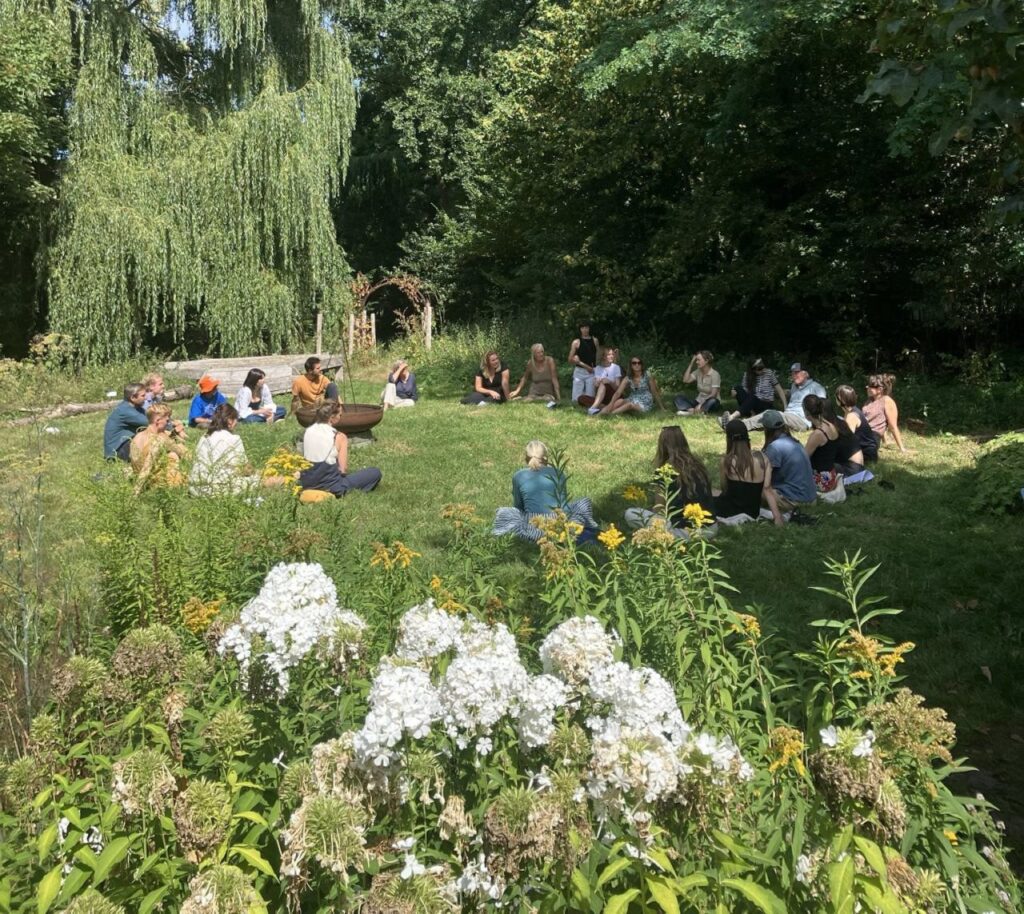
Unlike a conference, where the emphasis is often on presenting finished work, a summer school creates enough time for conversations to unfold. People cook and eat together, walk through on the land, sit around a fire, continue discussions long after the formal programme has ended, and slowly begin to understand one another’s work in a deeper way. There is time to play, to be curious, to laugh, to sing and wander, and to notice what emerges when nobody is rushing to the next session.
For me, those moments are not separate from the learning, they are the learning.
Last year people didn’t just leave with new ideas; they left with friendships, collaborations and a sense that they had found others walking a similar path. Several participants have stayed in touch throughout the year, and some are returning this August.
At Schumacher Action Labs we’ve started talking about commons literacy as a practice. By that we don’t mean understanding the theory of the commons, important though that is. I mean developing the practical capabilities that enable people to steward places and resources together: listening well, building trust, navigating conflict, sharing responsibility and learning to care for something larger than ourselves.
Those capacities are difficult to develop through reading alone. Like gardening, music or craftsmanship, they are learned through practice, through observation, through spending time together and through paying attention, to each other, to the place and to ourselves.
this is also part of the magic of what Schumacher College offers. Creating a different rhythm. Away from the pressure to produce, where learning is woven together with good food, nature, conversation, creativity and simple companionship. This is the ethos of Small is Beautiful. In an economy that values speed and efficiency, there is something quietly radical about slowing down enough for relationships and ideas to mature.
That is certainly our hope for this year’s International Schumacher Summer School.
From 18–21 August we’ll gather at Plaats de Kleine Aarde, a 50 year old ecological farm and learning center, in the Netherlands to explore commons, bioregionalism, regenerative finance, community stewardship and local economies. We’ll learn from one another, spend time outdoors, share meals, sing, reflect, and hopefully leave with a little more clarity, a few new friends and the confidence to continue the work back home.
If that sounds like something you have been looking for, we’d love to welcome you.